Showing posts with label artists. Show all posts

Sunday, 19 January 2020

Heads

A bit about some heads:


Yesterday I revisited 'The Ancestors' in the corridor between what I will always think of as the Museum of Mankind (now part of the Royal Academy) and the Royal Academy. Was at the RA for a discussion between Mary Beard, Cathie Pilkington and Alison Wilding about the exhibit and arrived early so I thought I should see Lucian Freud's portraits upstairs first - so by the end of the morning my head was full of heads; here's an article about the Freud exhibition. Was a fleeting visit and I might or might not go back to have a proper look.

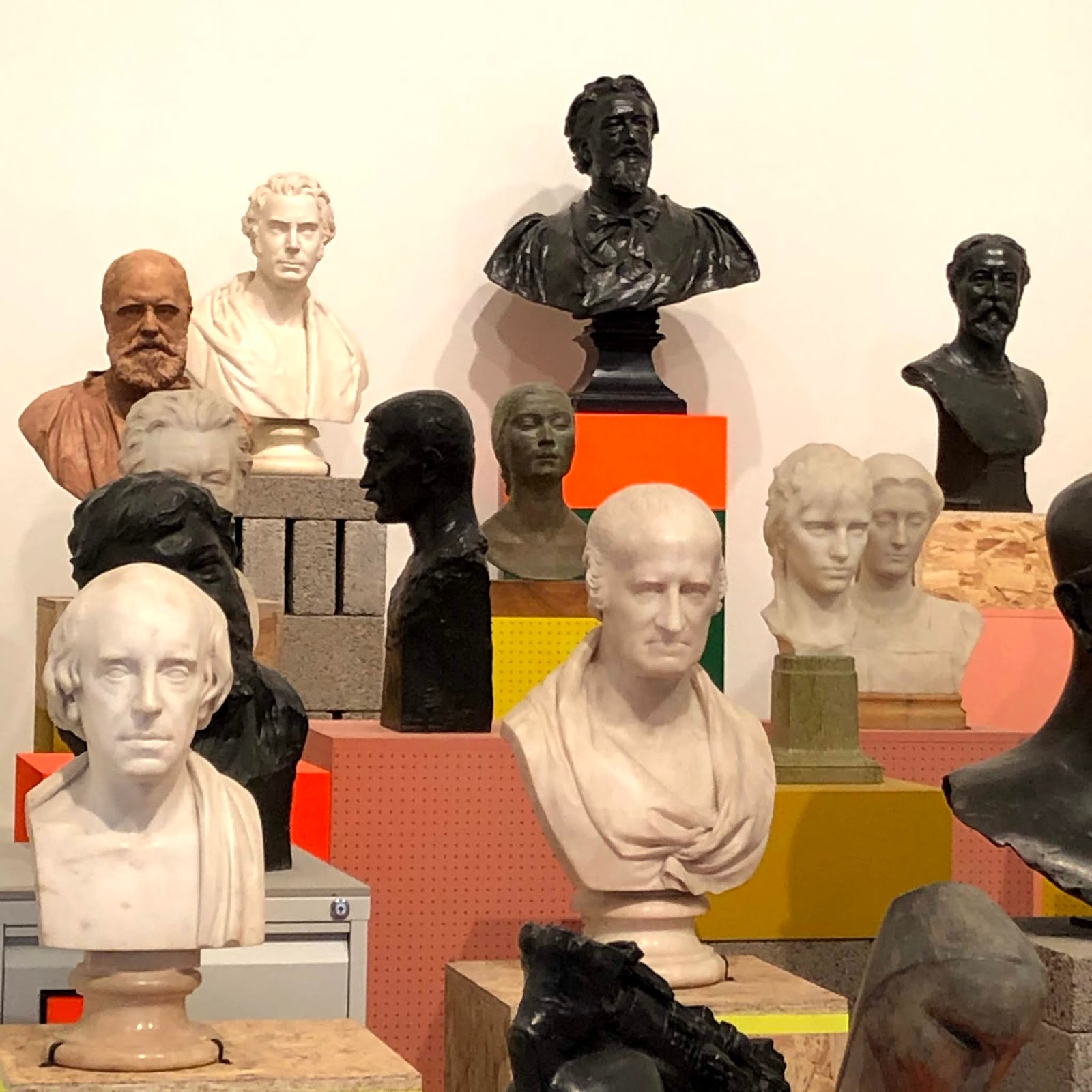
'The Ancestors' I will rave about. Think it's finishing any day now so I hope you managed to see it - if not there are many photographs and probably some videos online. Curated by Cathie Pilkington RA and Alison Wilding RA, It consists of busts, mostly taken from the RA collection and exhibited together, most facing forward but the odd one or two backwards or to the side, at different heights on ramshackle looking plinths arranged in a rectangularish block - you look at them and they look at you as you pass; you can pass either side as the corridor (or to give it it's full name: The Ronald and Rita McAulay Gallery) splits into two channels there; but I and many others stopped and looked properly.
Here's some details from the RA website, including information about specific busts.

Over 4000 people responded by leaving a drawing.  I'm trying to sum up what worked so well for me (partly in order to learn some lessons about how to encourage people to stop and engage):

lightness of touch - the exhibit didn't feel like it wanted to labour a point - although it was clearly full of intelligent thought.

lack of writing right next to the exhibits - was all on the wall facing it (and not too much of it) - apparently the labels from storage were originally left on but it meant people immediately began reading those instead of responding to the piece so they were removed.

informal and various plinths - I was particularly struck by the odd old metal filing cabinet being used as a plinth amongst breeze block plinths and some painted wood ones - because the arrangement of the busts was so clear and decisive the haphazardness of the plinths felt important and purposeful - took away some of the pomposity and also simply added some colour.

clever, clear engagement activity that needed no extra input and led to great results - people were invited to make their own pencil drawing and pin it to the growing board of pictures.

I'm so pleased I went to the talk as it clarified some of my thoughts about the exhibition and it was great to get some background and an insight into the way the artists worked together, many of the decisions (like deciding against leaving the storage labels on and the use of filing cabinets as plinths) came about at the last minute. The only piece borrowed (ie not from the RA collection) was the big 'Goggle Head' by Dame Elizabeth Frink RA - and initially it was thought that all of the sculptures would be shown on Frink style breeze block plinths but they would have been too heavy for the floor.

All in all very wonderful and loved listening to Cathie Pilkington and Alison Wilding discussing their thoughts and their seemingly different approaches that ultimately seem to spring from the same pool.


Tuesday, 10 July 2018

Saturday 14th July: Create Together, St Albans Museum and Gallery

Create Together, St Albans

Enjoying working on a collaborative project with groups of visitors at St Alban's Museum and Gallery.  Inspired by a wonderful installation by Susie MacMurray we are creating elements for a large scale piece using velvets, silks, sticks, bark and herbs.
Here are some pics of our work in progress:


And here is a detail of some of Susie MacMurray's work at St Albans Museum and Gallery; this is made from silk velvet and wire:


Tuesday, 11 October 2016

11th October 2016

Solo show this month at Artistsmeet in Rickmansworth.  Visual diary made over the past five years including books, animations, pictures and prints.Open evening tomorrow (12th October) from 5.30 - 7.00 followed by bookmaking workshop. Childrens drop-in workshop on Tuesday 25th: 12.00 - 2.00


Friday, 10 April 2015

David Batchelor


Went to the Whitechapel gallery the other day as I was nearby and was hoping to catch 'Adventures of the Black Square' again but it had finished.  So looked at David Batchelor's photographs of rectangles found in cities instead.  I liked the documented real slides on a large rectangular light box, particularly the way they were arranged in a symmetrical pattern, presumably because there weren't quite enough to fill the rectangle completely.  Found myself counting them and couldn't help noticing that there was a mistake in the way they were laid out - was tempted to surreptitiously slide two into what I think would have been a better order but luckily I stopped myself as I enjoy going there and I'd like not to be banned.

Here is David Batchelor talking about the show:


Sunday, 8 March 2015

Friday 6th March 2015

Richard Long

Delighted that my friend Melior and I were present when Richard Long talked about his work, with an accompanying slide show at the V&A this evening.  This was a lecture in memory of silversmith,  Pamela Rawnsley, who shared Long’s appreciation of walking and landscape.  I first came across Long, along with David Nash and Andy Goldsworthy about thirty years ago and was inspired to go into the woods and make sculpture from found materials.  I have seen his work in a number of exhibitions including a major retrospective, Heaven and Earth, at Tate Britain a few years ago that included: large scale mud drawings on walls, stone circles on floors and books. (See the link below for more information about that exhibition.)
At seventy, Long continues to work with energy and enthusiasm, still walking and still exploring new processes.  He is an imposing figure, at least 6’ tall and he speaks quietly but confidently.

The talk began with standard information about Long’s work, disarmingly unconnected to the accompanying slide show which was on a loop.  He read from notes describing his way of working and some of the actual projects; he several times reinforced the concept of his work being about place, time and himself. 

It was when people started asking questions that it got more interesting.  Not that any were controversial or challenging – it’s just that the conversational aspect of this section made it seem more lively and potent.  Some of the questions that were addressed and the responses can be read below. (Please excuse the paraphrasing and bear in mind that these are the things I noticed, rightly or wrongly!):

How important is the photography to you and what is the process, camera etc?
Answer – very important, a crucial part of the art, to document and explain what has been created, made, thought.  Real black and white film, developed by an expert (who was sitting in the front row).  The photographs can be art in their own right, part of a book, or part of an explanatory slide show ‘like this’.

Is it a compromise making work in a gallery, compared with responding to walking in the great outdoors?
Answer – no.  I am the same artist, responding to different situations, opportunities.

Do you make any connection between pre-Christian religious symbolism (are you picking up on some earthly force) in view of the fact that some of your work looks like those kind of prehistoric sculptures?
Answer – no.  I am not religious.  Clearly many of the simple shapes and symbols in my work coincide with simple shapes and symbols from other cultures, religions, ways of thinking.  (Long made it clear that he is interested in working with simple universal shapes rather than creating his own shapes.)

Other questions led to explanations of how he started working on the walks as a student.  He described how Anthony Caro ruled at St Martin’s but his modernist steel work was considered uninteresting by Long and his close contemporaries.  He described the way Henry Moore seemed ancient and beside the point.  He said he was young and wanted to find new ways of making art.  Earlier on he had explained that his work was influenced by many things including Art Povera and Land Art.  He also said that as a teenager he liked Van Gough, Cezanne and made drawings and paintings. 

Long considers himself an artist and not an explorer.  Neither does he think of himself as a performer (despite that fact that his work can seem like a performance at times).  He was very quick to respond to all of the questions and very sure about how to respond, presumably having met the same questions quite a few times over the past fifty years.

Overall I really enjoyed the evening, particularly the questions and answers (for which I was suddenly wide-awake). 

As I had moved all my stuff out of my studio this morning, I was particularly heartened by the idea of the whole world serving as a studio, rather than a particular room acting as a purveyor for particular processes/materials. 
He said that the only thing he takes in his rucksack apart from a camera is a ball of string (this was in response to a question about how he marks out the circles).

He also explained that most walks are made alone or with a guide if necessary, although he has walked (collaborated) with other artists.  He said that as he gets older the walks might become shorter or slower.

Occasionally he answered ‘no’ to something very quickly and then proceeded to contradict himself.  I got the feeling that his firm dismissal of people’s misunderstanding of the intentions behind his work emanates from years of irritating misunderstandings, leading to emphasis on aspects of the work that are not important to him.  For instance somebody asked him about maths in his work and he was very quick to point out that he is not a mathematician and can’t add up.  However he clearly does have some interest in maths, in universal shapes and even in concepts like the Fibonacci sequence (which was used for at least one of his walks).


Happiness
by Emily Carr


Last week I went to see Canadian artist Emily Carr's work at Dulwich Picture Gallery with my friend Lise.  Although Carr is best known for work inspired by aboriginal coastal communities: totem poles, and other symbolic cultural icons, the works I particularly like are the paintings made in woods.  One, called ‘Happiness’ was made in the last years of her working life.  It looks as if it was made quite quickly, on large paper, using oil paints, thinned with some kind of mixer (not sure what it was).  Apparently she would spend time in a wood, looking at a particular view and then, eventually paint quite quickly.  That is how I like to work too and probably why I feel such an affinity with these paintings, of which there are many, all very moving and exciting.  

Here's "Happiness" by Emily Carr